

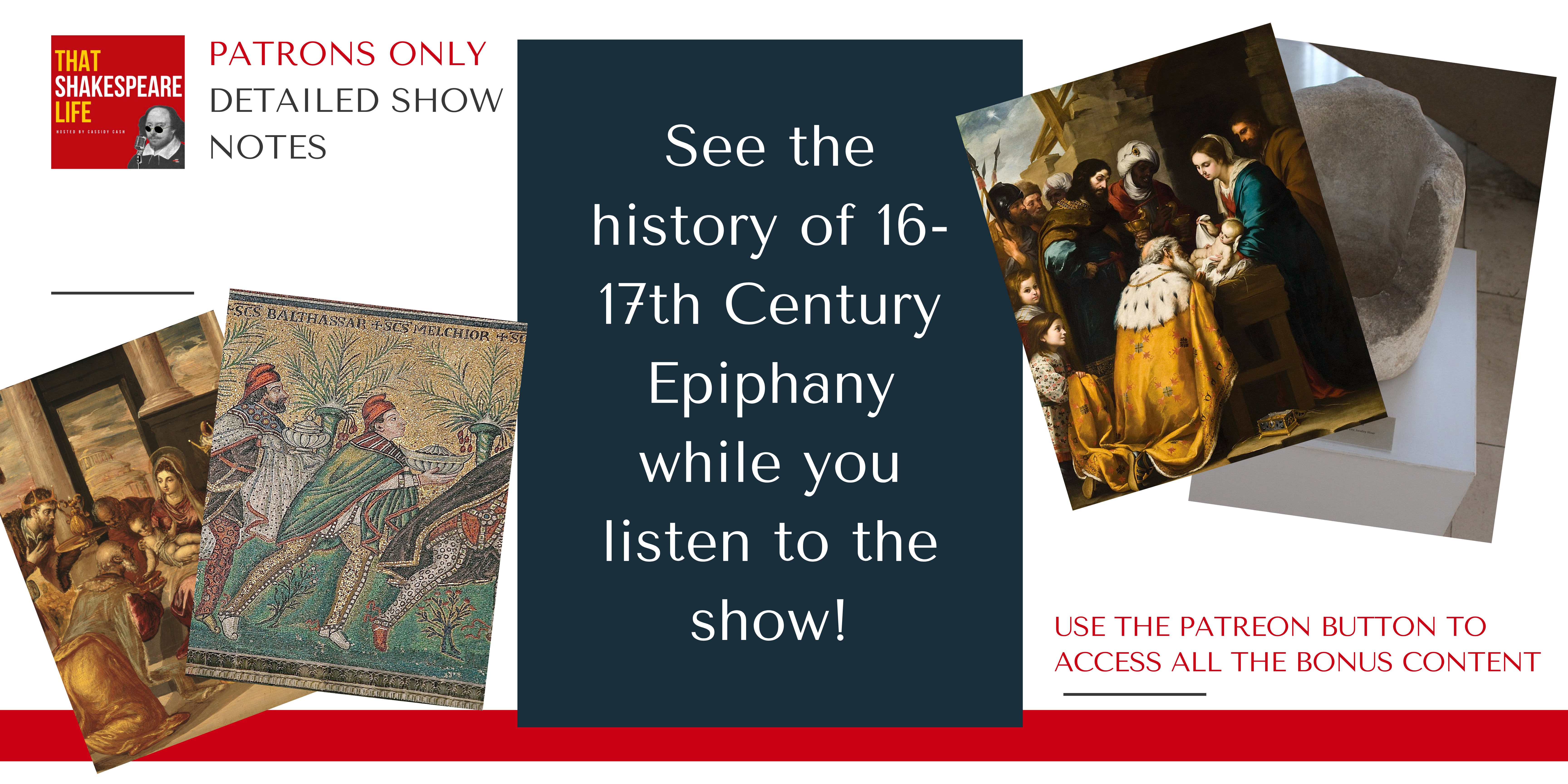
January 6 is the day that many celebrate a holiday called Epiphany, the first manifestation of Jesus as the Son of God to the Gentiles, which happened through the visit of the Magi, or the Three Kings, who visited Jesus and brought him the now famous gifts of gold, frankincense, and myrr. The holiday was celebrated in Shakespeare’s lifetime, but just like today when the holiday is marked by cultural and regional variations for exactly what those celebrations will include, Epiphany in the 16-17th century was unique as well. Here today to walk us through the history of Epiphany and how it was celebrated in Shakespeare’s lifetime is our guest, Beatrice Groves.
Subscribe on your favorite listening platform and please leave us a rating & review. Every rating and review helps the show!
Subscribe
Itunes | Stitcher | TuneIn | GooglePlay
Download a rough, edited transcript here

Beatrice Groves
Dr Beatrice Groves is the Research Fellow and Lecturer in Renaissance English at Trinity College, Oxford. She has published books on both Renaissance literature – The Destruction of Jerusalem in Early Modern English Literature (Cambridge University Press, 2015); Texts and Traditions: Religion in Shakespeare, 1592-1604 (Oxford University Press, 2007) and Harry Potter: Literary Allusion in Harry Potter (Routledge, 2017). She has recently published a number of articles on Shakespeare, early modern marginalia and the psalms and is working on a monograph on early modern sonnets and psalms. Her Harry Potter work can found on a number of podcasts and blogs, see: https://www.hogwartsprofessor.com/beatrice-groves-pillar-post/ and her dedicated blog spot ‘Bathilda’s Notebook’ https://www.mugglenet.com/the-quibbler/bathildas-notebook/
I’ll be asking Beatrice Groves about:
- Modern Day celebrations of Epiphany sometimes refer to it as “Little Christmas” because it marks the end of the Christmas holidays. Would Epiphany have been celebrated as part of the Christmas season during Shakespeare’s lifetime?
- As Epiphany marks the commemoration of the Magi bringing gifts to the young Jesus, would this holiday have been marked by the giving of gifts in the 16-17th century?
- Were there any foods or drinks that were traditionally associated with Epiphany in Shakespeare’s lifetime?
- …and more!
Books and Resources Beatrice Groves recommends:
(references to “I” here are from Beatrice. These notes are from her to you, so you can learn more about Epiphany!)
- The Clerk of Oxford blog, which is a uniquely wonderful blog for anyone interested in the liturgical year (I’ve chosen her Epiphany section here) https://aclerkofoxford.blogspot.com/search/label/Epiphany
- Ronald Hutton’s The Rise and Fall of Merry England: The Ritual Year 1400-1700 (1994) – the incomparable book on the ritual year, crammed with fascinating detail https://www.amazon.co.uk/Rise-Fall-Merry-England-1400-1700/dp/0198203632
- An article I wrote about a Christmas carol from the Coventry mystery plays – a direct medieval inheritance in the early modern festal year by which I think Shakespeare was directly influenced:https://www.theschooloftheology.org/posts/essay/hymns-and-carols-coventry-carol
- My twitter feed – tying together literature, nature, folklore and the rhythms of the natural and liturgical year
Comment and Share
That Shakespeare Life is always excited to connect with fellow Shakespeareans who love learning something new about the bard. Subscribe to our show on your favorite listening platform, and please consider leaving us a rating and a review to help our show reach new listeners!
That’s it for this week! Thank you for listening! I’m Cassidy Cash and I hope you learn something new about the bard.
I’ll see you next time!
