

Access over 150 additional episodes in our back catalog on Patreon! Join today at http://www.patreon.com/thatshakespearelife
The life of Henry VIII was recent history for Shakespeare and stereotypes we associate with Henry VIII today, like chowing down on a turkey leg, for example, weren’t in existence for Shakespeare’s lifetime. Shakespeare helps us understand the early 17th century opinion of Henry VIII tremendously with his play all about King Henry and his famous cast of characters including Anne Boleyn and Cardinal Wolsey. Shakespeare’s version of Henry VIII’s life is called All is True by contemporary accounts of the play, being given the title Henry VIII for the publication of the First Folio in 1623. Ironically, it was during a performance of All is True that a canon fire being used as special effects burned down the Globe theater in 1613. Here today to help us understand what the stereotypes were for Shakespeare, was politics or propaganda were at play in the writing of All is True, and to share the real story of the actual Henry VIII as he would have been known during the life of William Shakespeare is our guest and historian, Kat Marchant.
Subscribe
Itunes | Stitcher | TuneIn | GooglePlay

Katrina Marchant earned her PhD in early modern literature and culture from the University of Sussex in 2015. She is the creator of the YouTube channel “Reading the Past”. Every week she researches, writes, films, edits, uploads and promotes historical education content to the channel. The channel explores, among other things, biographies (particularly relating to women’s history), significant moments in our past and material and textual history. “Reading the Past” has 119,000+ subscribers, 11.1 million total views and 2.6 million hours of watch time. She has worked as an educator and historic interpreter, as well as an expert contributor on multiple history documentaries for the BBC and Channel 4.
Her thesis – ‘Things “Necessary” and “Unnecessary”: Trash and Trifles in Early Modern England’ – illustrates how the deployment of the terms trash and trifles in early modern England can be productively used to trace the shaping of the Protestant English commonwealth as a distinct, secure and valuable entity in an unstable and increasingly global post-Reformation world.
Katrina has worked as a freelance Globe Education Lecturer at Shakespeare’s Globe, in this role she wrote and delivered lectures, workshops and tours for visiting higher education students. In these sessions she explored theatrical, social, material and literary history to provide context for the reconstructed spaces on the Globe site and the plays by William Shakespeare that are performed there.
She is also an educator (for primary and secondary aged visiting school groups) and live costumed historic interpreter at various heritage sites in the United Kingdom. As an educator, she delivers curriculum specific sessions on the historic events connected to the specific site; for example, leading key stage 3 sessions at the Natural History Museum as the nineteenth-century palaeontologist Mary Anning. Her interpretation work takes the form of first-person performance (both scripted and improvised) as various individuals from the span of British History; again, these individuals will be connected to the site in which the performance is taking place (i.e. representing Sarah Churchill, Duchess of Marlborough and companion of Queen Anne in scripted scenes and improvised “meet and greet” sessions at Hampton Court Palace).
She was an expert contributor for: 5Select’s “Lady Rochford”; a documentary about the life and legacy of Jane Boleyn, Lady Rochford (Anne Boleyn’s sister-in-law), which was presented by Tracy Borman and that first aired in 2021; “The People’s Piazza: A History of Covent Garden”, which explored the history of the site over the last 400 years, this documentary was presented by David Olusoga and first aired on BBC 2 in 2022; and “Queens That Changed the World” – Episode 1 on Queen Elizabeth I and Episode 2 on Queen Anne, which first aired on Channel 4 in 2023.
I’ll be asking Kat Marchant about:
- It seems intentional that Shakespeare’s play about Henry VIII was not performed until after Elizabeth I’s death in 1603. Was it safer, politically, to perform this play after Elizabeth was gone?
- Shakespeare usually has his finger on the pulse of contemporary interest with the subjects he writes about, which makes me wonder if Henry VIII was something of a pop culture icon for Jacobean England. What was the opinion of Henry VIII and his story with Anne Boleyn culturally for Jacobean England?
- At a banquet thrown by Wolsey, the King and his attendants enter in disguise as masquers, and The King dances with Anne Bullen. Do we know if Henry VIII actually did dress up in disguise for events, and is that how he met Anne Boleyn in real life, at a party?
- …and more!
Resources Recommended by Our Guest
Raphael Hollinshed’s Chronicle
The State Papers for Henry’s reign
Related Episode

History of Tewskbury Mustard
An anecdotal tale about Henry VIII and Anne Boleyn was that they supposedly enjoyed Tewksbury Mustard. Explore the history of this famous condiment that was fit for a Queen and his Queen with our guest, Robin Ritchie.
Products From Our Shop:
-
 This Shirt Makes HistoryPrice range: $25.00 through $30.00
-
 Stratford Upon Avon: Shakespeare’s Houses Illustrated Map$18.00
-
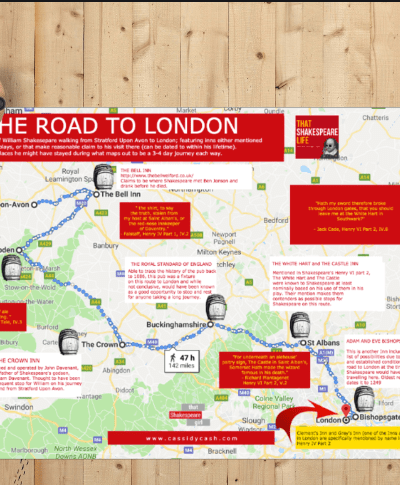 Walk To London Diagram$14.00
-
 Holy Trinity Church Hand Illustrated Digital Print$7.00
-
 Digital Printable Timeline of William Shakespeare’s Life$11.00
-
 This Sweatshirt Makes HistoryPrice range: $78.00 through $84.00

This post expands! There are detailed show notes that accompany today’s show. Use the Patreon buttons available on this page to sign up at the $5/month level or higher and immediately open these show notes and all the others on our website (that’s over 300 shows!)
Here’s what inside this episode’s Detailed Show Notes:
- Painting of the Tudors from 1590
- Illustration of Henry VIII with a harp, c 1530
- Portrait of Anne Boleyn painted around the time Shakespeare wrote All is True
- Portrait of Anne Boleyn from 1545
- Title page of Henry VIII, c. 1632
- Hand illustrated woodcut of Henry VIII on horseback, c. 1570s
- Edward VI’s “devise for the succession”, 1553
- Portrait of Thomas Cranmer and his trial/execution

Comment and Share
If you like our show, please leave us a comment and a rating on the podcast platform you’re listening from today. Taking the time to rate us on Apple Podcasts or other platforms really helps our rankings and lets other people hear about the show. If you can drop us a rating and review, we’d really appreciate it!
If you’re listening right here in the show notes, please leave us a comment down below. We’d love to hear from you!
You can share this episode on social media to help more people hear about our show and the great history we talk about each week! Tweet this episode using this link or share the website on Facebook, Instagram, Pinterest or LinkedIN.
If you want even more episode of That Shakespeare Life, be sure to check out our Patreon page. There’s over 150 additional episodes there that aren’t available on public listening platforms. PLUS there’s some great bonuses just for patrons.
That’s it for this week! Thank you for listening. I’m Cassidy Cash, and I hope you learn something new about the bard. I’ll see you next time!

Thus far the best discussion I’ve heard on ‘Henry VIII.’ I would be interested to know Dr. Kat’s comments on the collaborative efforts of John Fletcher who also worked on the play with Shakespeare. Does Dr. Kat think Fletcher made any major contributions to the plot or characters? Are there any glaring stylistic differences that indicates a “Shakespeare” or “Fletcher” plot, or style of writing? Thanks for an interesting podcast.
PS. It would be of great interest to see this play reimagined on the stage.
Hi Jim,
I’m so pleased you liked the episode! I had a great time chatting with Cassidy!
There has been some interesting developments in the use of AI to analyse the plays that are believed to be co-authored. While one earlier example suggested Shakespeare was responsible for the whole play; a 2019 study points to a switching between playwrights as the play moves along. A couple of scenes by Fletcher, a couple by Shakespeare and some a mix. It is fascinating!
Thanks for your reply. A fascinating topic to be sure. It will be a curious thing as more plays are analyzed by AI technology in a Sherlock Holmes-style whodunnit (or not do it). A Time Machine would solve any lingering questions…
We listen to your podcast as carefully as we listen to that Shakespeare Life. 😉
Thanks for your reply!
It will be interesting to see what AI technology reveals in the future of Shakespearean studies. We enjoy listening to your podcast alongside That Shakespeare Life.