
Shakespeare has nine references to Indians throughout his plays, including one written in 1613 for the play Henry VIII that describes an Indian making quite a stir when he appears at court. He also writes in A Midsummer Night’s Dream about a lovely Indian boy who was stolen from an Indian King.
These references become more haunting as we understand the real-life story of one very famous Indian from North America, namely Squanto.
You have likely heard of Squanto before, but you may be surprised to learn that Squanto was not only alive during the life of William Shakespeare, but that he travelled from North America to Europe and even lived in London the same time Shakespeare was writing some of his lines about Indians in his plays.
Squanto is, of course, remembered today as the hero of the First Thanksgiving, providing knowledge and assistance that allowed the Pilgrims to survive their first harsh winters in Massachussetts.
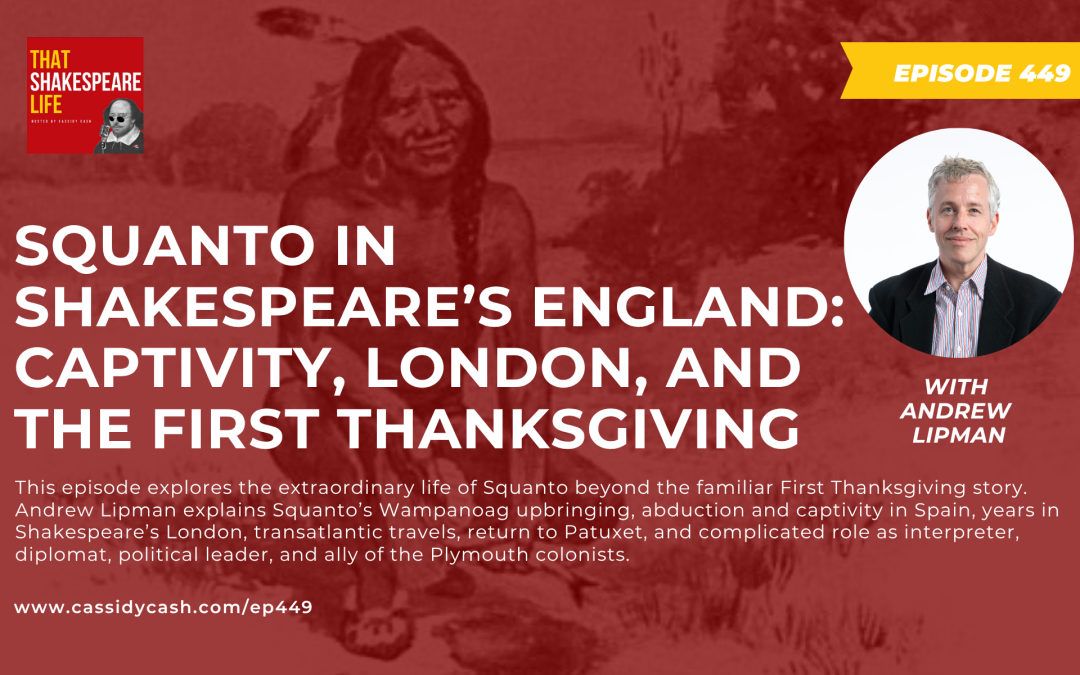
Our guest this week, Andrew Lipman, history professor at Barnard College and Columbia University, has recently published a book titled “Squanto: A Native Odyssey” that aims to explore the life of Squanto both before and after his famous acts at Plymouth, to unravel myth from fact, and tell not only a more complete story, but to share previously unknown evidence about the life and mysterious death of Squanto.
So pull up a chair, grab your cup of coffee or tea, and join us at the history table right now as we pull back the curtain on one of history’s most famous men, and explore how the life of Squanto overlaps with William Shakespeare.
Download a Transcript of Ep 449 here

About Andrew Lipman
Andrew Lipman is a historian of Early America and the British Atlantic world and a professor at Barnard College, Columbia University. His first book, The Saltwater Frontier (2015), won the Bancroft Prize in American History, and his second book, Squanto: A Native Odyssey (2024), won four prizes, including the PROSE Award in Biography.
What we talk about:
- How Squanto was abducted from New England in 1614, taken to the slave-trading port of Málaga, and eventually transported to London, where he lived during Shakespeare’s final years.
- What Squanto’s life in Shakespeare’s London, proximity to Pocahontas, and experience learning early modern English can tell us about Native people living in England during Shakespeare’s lifetime.
- How Squanto returned to a homeland devastated by epidemic disease, became essential to relations between the Wampanoag and Plymouth colonists, and developed a much more complicated political legacy than the familiar First Thanksgiving story suggests.
Recommended Resources:
- William Bradford, Of Plimoth Plantation — the newer authoritative edition edited by Jeremy Bangs, with a prologue by Paula Peters, a Wampanoag historian. Andrew calls this the best recent edition. (Cassidy notes the original is available for free on Project Gutenberg)
- Edward Winslow, Good Newes from New England, edited by Kelly Wisecup — particularly valuable because it was published soon after Squanto’s death, contains an account of his death, and preserves details of early Wampanoag life. Andrew argues Squanto can sometimes be understood as an uncredited source behind information preserved in works like this. | Cassidy Notes that an original version of this book is also available for free on archive.org as well as Project Gutenberg
- David J. Silverman, This Land Is Their Land — Andrew recommends this for the broader history of the Wampanoag Nation.
- Andrew Lipman, The Saltwater Frontier: Indians and the Contest for the American Coast — his earlier book examining Native and European interaction along the northeastern coast, with particular attention to Native maritime culture.
- Andrew Lipman, Squanto: A Native Odyssey — the featured book for this episode, reframing Squanto’s life through captivity, transatlantic travel, cultural adaptation, Native diplomacy, and the complicated politics of Plymouth.

